GALLERIES > BIRDS > PASSERIFORMES > TURDIDAE > VEERY [Catharus fuscescens] [plot on map]
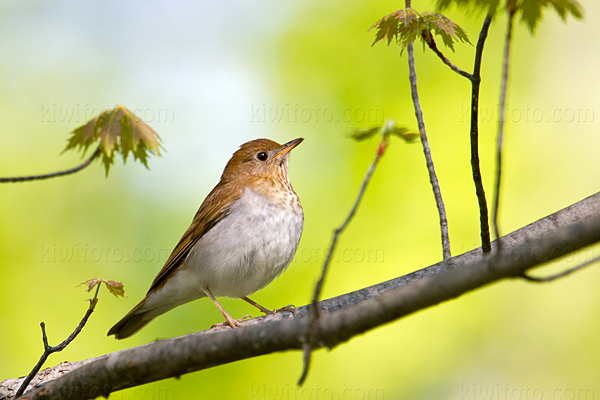
Location: Maumee Bay State Park, OHGPS: 41.7N, -83.4W, elev=577' MAP Date: May 13, 2017 ID : B13K5051 [4896 x 3264]
|
|

|
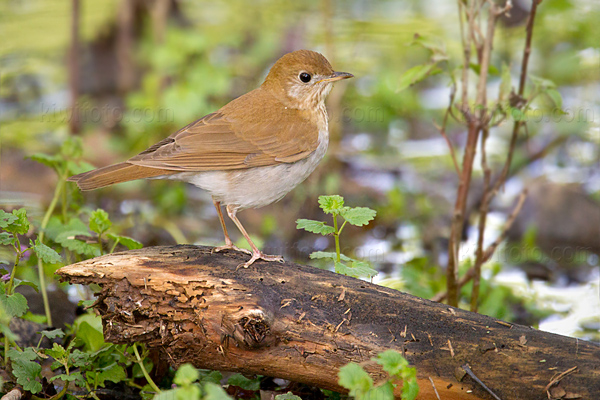
Location: Maumee Bay State Park, OHGPS: 41.7N, -83.4W, elev=577' MAP Date: May 12, 2017 ID : B13K4785 [4896 x 3264]
|
|
|
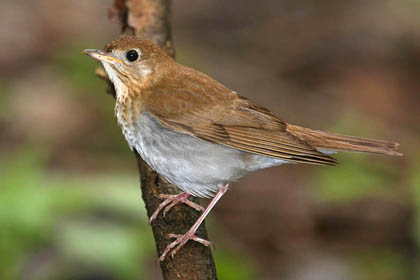
Location: Magee Marsh (Crane Creek), OHGPS: 41.6N, -83.2W, elev=573' MAP Date: May 3, 2008 ID : 9887 [3888 x 2592]
|
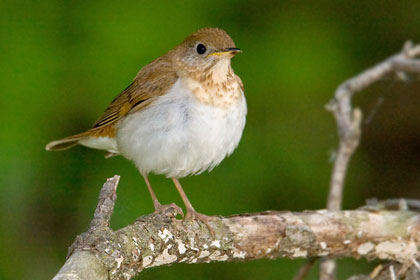
Location: Magee Marsh (Crane Creek), OHGPS: 41.6N, -83.2W, elev=573' MAP Date: May 9, 2010 ID : 7C2V7958 [3888 x 2592]
|
|
Location: Magee Marsh (Crane Creek), OHGPS: 41.6N, -83.2W, elev=573' MAP Date: May 3, 2008 ID : 0620 [3888 x 2592]
|
Location: Magee Marsh (Crane Creek), OHGPS: 41.6N, -83.2W, elev=573' MAP Date: May 3, 2008 ID : 9906 [3888 x 2592]
|
|
Location: Magee Marsh (Crane Creek), OHGPS: 41.6N, -83.2W, elev=573' MAP Date: May 3, 2008 ID : 0606 [3888 x 2592]
|
Location: Magee Marsh (Crane Creek), OHGPS: 41.6N, -83.2W, elev=573' MAP Date: May 3, 2008 ID : 9883 [3888 x 2592]
|
|
Location: Magee Marsh (Crane Creek), OHGPS: 41.6N, -83.2W, elev=573' MAP Date: May 3, 2008 ID : 9920 [3888 x 2592]
|
|
SPECIES INFO
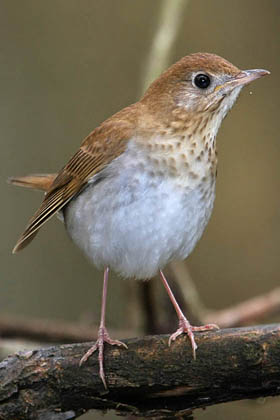
The Veery, Catharus fuscescens, is a small thrush species. It is occasionally called Willow Thrush or Wilson's Thrush. This species is 16-18 cm in length, and has the white-dark-white underwing pattern characteristic of Catharus thrushes. It is a member of a close-knit group of migrant species which also includes the cryptotaxa Gray-cheeked Thrush and Bicknell's Thrush (Winker & Pruett, 2006).
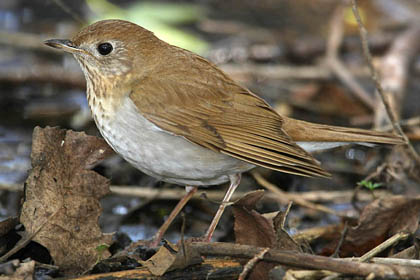
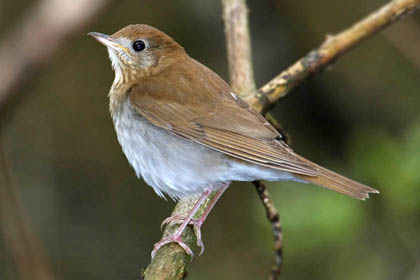
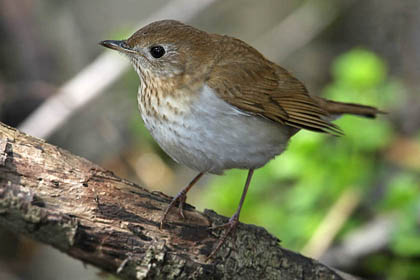
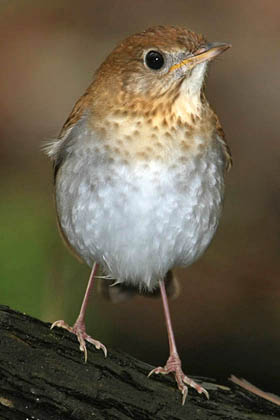
Adults are mainly light brown on the upperparts. The underparts are white; the breast is lighter brown with dark spots. They have pink legs; their eye ring is indistinct. Birds in the east are more cinnamon on the upperparts; western birds are more olive-brown.
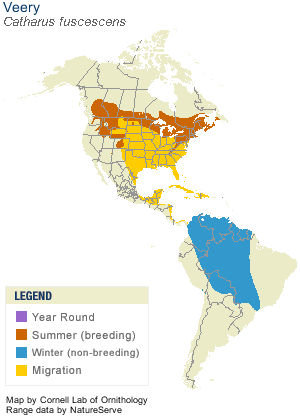
Their breeding habitat is humid deciduous across southern Canada and the northern United States. They make a cup nest on the ground or near the base of a shrub.
These birds migrate to eastern South America. They are very rare vagrants to western Europe.
They forage on the forest floor, flipping leaves to uncover insects; they may fly up to catch insects in flight. They mainly eat insects and berries.
This bird has a breezy downward-spiralling flute-like song, often heard from a low but concealed location. The most common call is a "vee-er", which gave this bird its name.
This bird has been displaced in some parts of its range by the Wood Thrush. They also suffered occasionally from brood parasitism by Brown-headed Cowbirds.
|
|