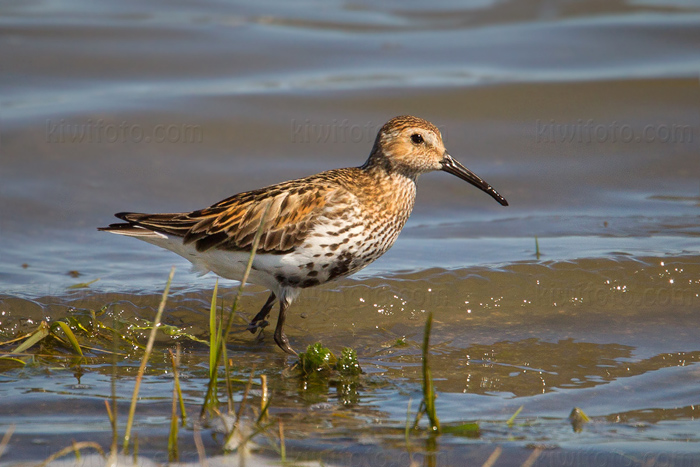
GALLERIES > BIRDS > CHARADRIIFORMES > SCOLOPACIDAE > DUNLIN [Calidris alpina] [plot on map]
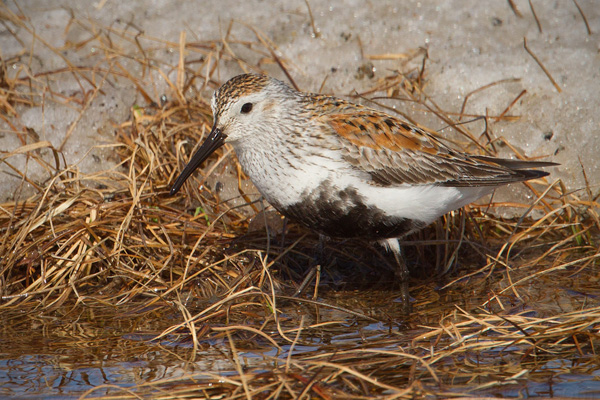
Location: Grotta, Reykjavik, IcelandGPS: 64.2N, -22.0W, elev=4' MAP Date: June 20, 2018 ID : B13K7677 [4896 x 3264]
|
|

|
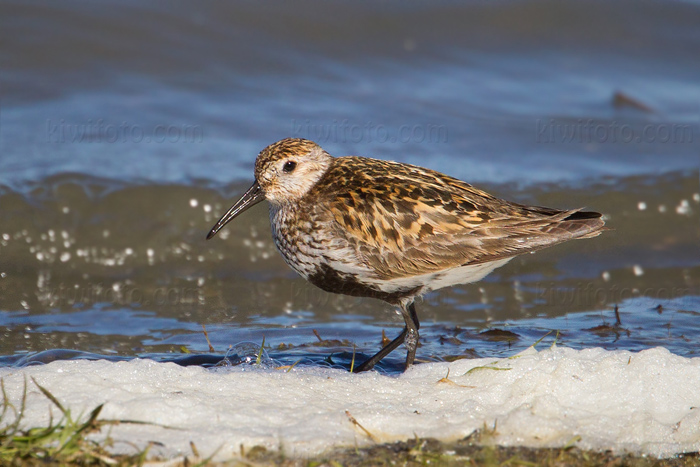
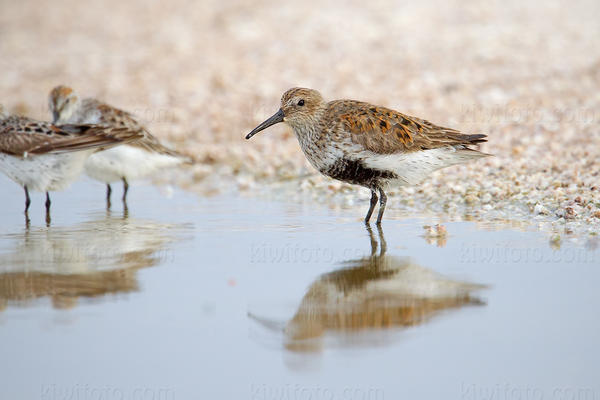
Location: Grotta, Reykjavik, IcelandGPS: 64.2N, -22.0W, elev=4' MAP Date: June 20, 2018 ID : B13K7659 [4896 x 3264]
|
|
|
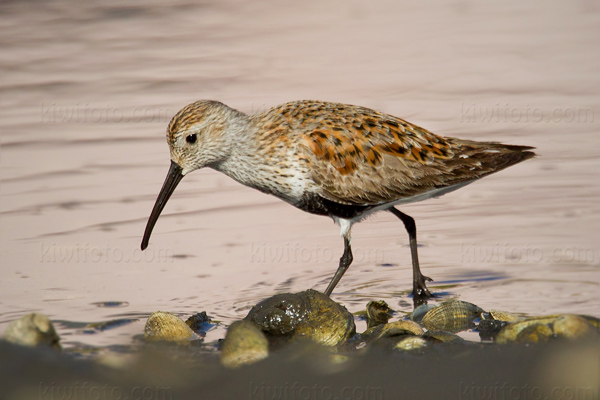
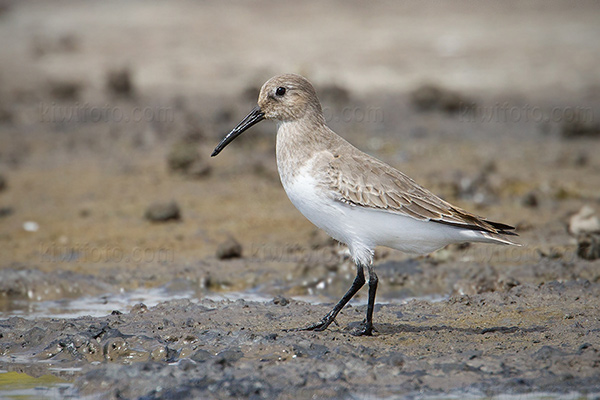
Location: Playa del Rey (Ballona Creek), CAGPS: 34.0N, -118.4W, elev=0' MAP Date: April 29, 2017 ID : B13K4571 [4896 x 3264]
|
|
|
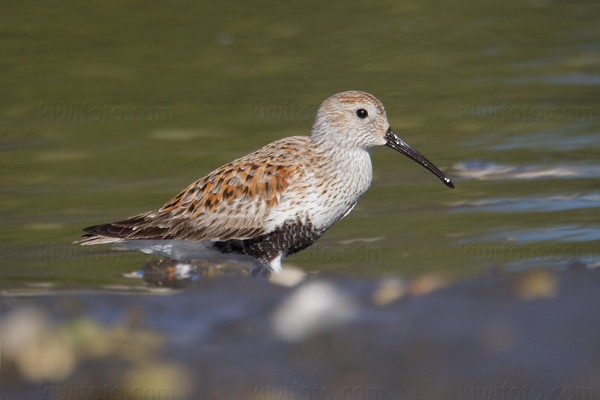
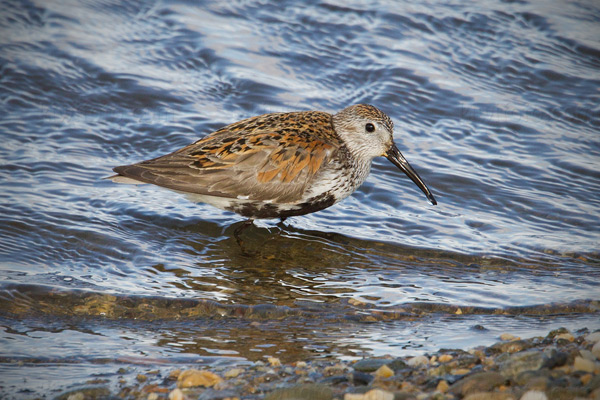
Location: Playa del Rey (Ballona Creek), CAGPS: 34.0N, -118.4W, elev=0' MAP Date: April 29, 2017 ID : B13K4562 [4896 x 3264]
|
|
|
Location: Barrow, AKGPS: 71.2N, -156.3W, elev=24' MAP Date: June 8, 2012 ID : B13K0213 [4896 x 3264]
|
|
|
Location: Salt Creek, Salton Sea, CAGPS: 33.4N, -115.8W, elev=-225' MAP Date: April 6, 2016 ID : B13K1416 [4896 x 3264]
|
|
|
Location: Kealia Ponds, Maui, HawaiiGPS: 20.8N, -156.5W, elev=170' MAP Date: October 21, 2015 ID : B13K9547 [4896 x 3264]
|
|
|
Location: Teller Road, Nome, AKGPS: 65.3N, -166.4W, elev=20' MAP Date: June 6, 2012 ID : B13K0074 [4896 x 3264]
|
|
|
Location: Newbiggin-by-the-Sea, Northumberlands, United KingdomGPS: 55.2N, -1.5W, elev=7' MAP Date: December 30, 2011 ID : B13K1988 [4896 x 3264]
|
|
|
Location: Playa del Rey (Ballona Creek), CAGPS: 34.0N, -118.4W, elev=0' MAP Date: October 22, 2011 ID : B13K9350 [4896 x 3264]
|
|
|
Location: San Jacinto Wildlife Area, CAGPS: 33.9N, -117.1W, elev=1,426' MAP Date: October 15, 2011 ID : B13K9315 [4896 x 3264]
|
|
|
Location: San Jacinto Wildlife Area, CAGPS: 33.9N, -117.1W, elev=1,426' MAP Date: October 15, 2011 ID : B13K9308 [4896 x 3264]
|
|
|
Location: Playa del Rey (Ballona Creek), CAGPS: 34.0N, -118.4W, elev=0' MAP Date: January 30, 2011 ID : B13K7482 [4896 x 3264]
|
|
|
Location: Newport Beach, CAGPS: 33.7N, -117.9W, elev=17' MAP Date: November 7, 2009 ID : 7C2V4696 [3888 x 2592]
|
Location: Salton Sea, CAGPS: 33.2N, -115.6W, elev=-232' MAP Date: May 2, 2009 ID : 7C2V7181 [3888 x 2592]
|
|
Location: Magee Marsh (Crane Creek), OHGPS: 41.6N, -83.2W, elev=573' MAP Date: May 16, 2010 ID : 7C2V9032 [3888 x 2592]
|
Location: Magee Marsh (Crane Creek), OHGPS: 41.6N, -83.2W, elev=573' MAP Date: May 16, 2010 ID : 7C2V9041 [3888 x 2592]
|
|
Location: Magee Marsh (Crane Creek), OHGPS: 41.6N, -83.2W, elev=573' MAP Date: May 3, 2008 ID : 0203 [3888 x 2592]
|
Location: Magee Marsh (Crane Creek), OHGPS: 41.6N, -83.2W, elev=573' MAP Date: May 3, 2008 ID : 0221 [3888 x 2592]
|
|
Location: Jekyll Island, GAGPS: 31.1N, -81.4W, elev=7' MAP Date: February 10, 2008 ID : 3707 [3888 x 2592]
|
Location: Ballona Lagoon, CAGPS: 34.0N, -118.5W, elev=2' MAP Date: April 10, 2006 ID : 2280 [3888 x 2592]
|
|
SPECIES INFO
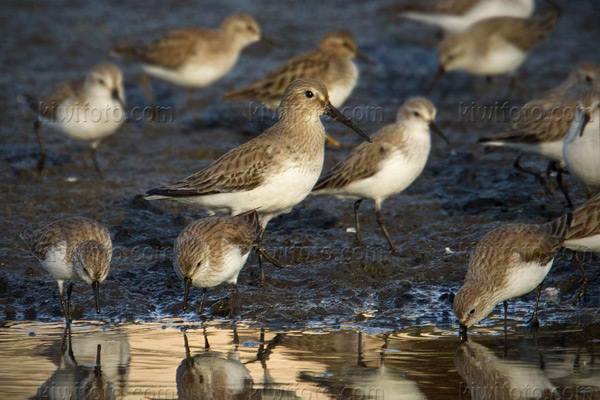
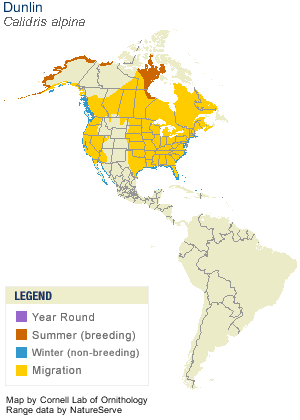
The Dunlin, Calidris or Erolia alpina, is a small wader. It is a circumpolar breeder in Arctic or subarctic regions. Birds that breed in northern Europe and Asia are long-distance migrants, wintering south to Africa and southeast Asia. Birds that breed in Alaska and the Canadian Arctic migrate short distances to the Pacific and Atlantic coasts of North America.
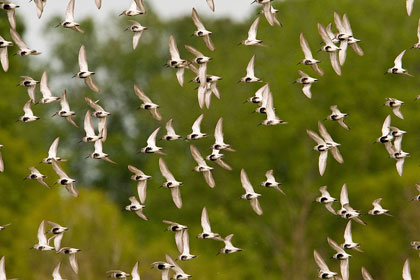
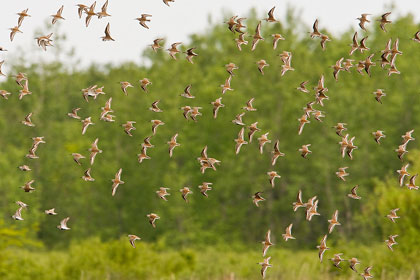
The Dunlin is highly gregarious in winter, sometimes forming large flocks on coastal mudflats or sandy beaches. Large numbers can often be seen swirling in synchronized flight on stop-overs during migration or on their winter habitat.
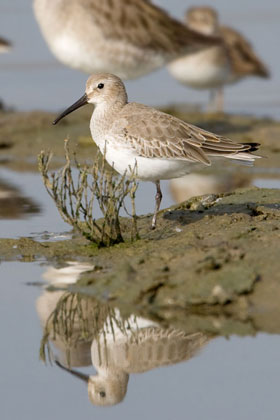
This bird is one of the most common and best-known waders throughout its breeding and wintering ranges, and it is the species with which other waders tend to be compared. At 17-21 cm length and a 32-36 cm wingspan, it is similar in size to a Common Starling, but stouter, with a thick bill.
It shows a strong white wingbar in flight, and it moves along the coastal mudflat beaches it prefers with a characteristic "sewing machine" feeding action, methodically picking small food items. Insects form the main part of the Dunlin's diet on the nesting grounds; it eats mollusks, worms and crustaceans in coastal areas.
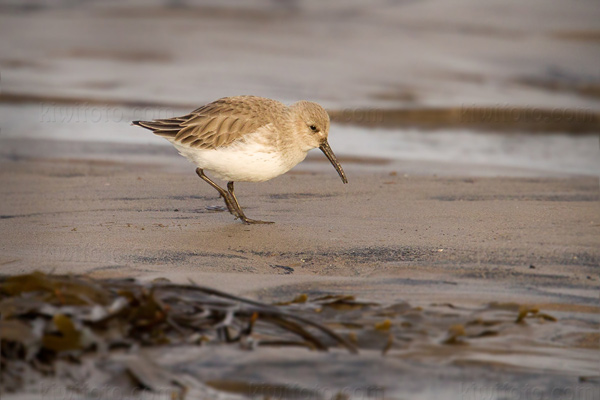
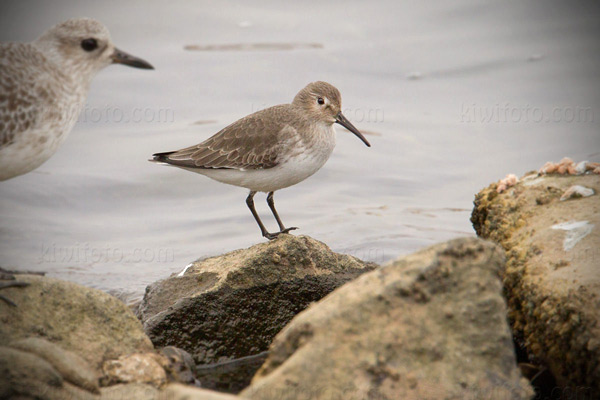
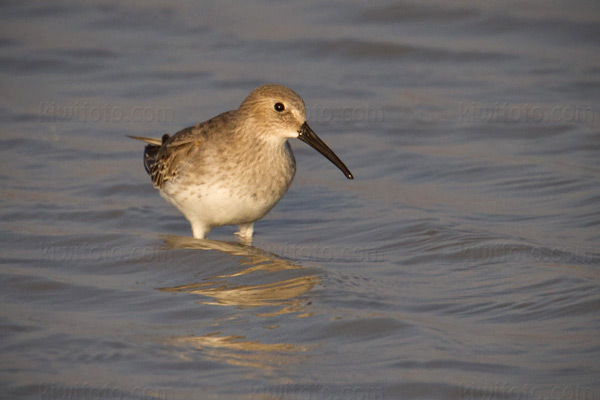
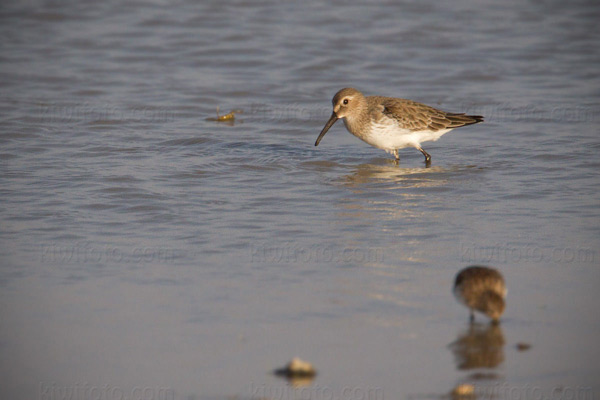
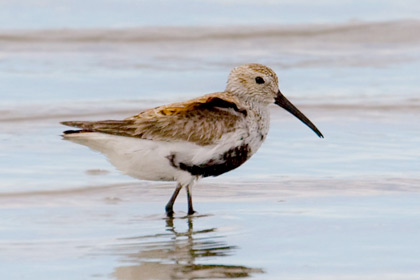
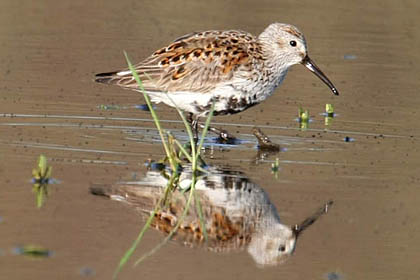
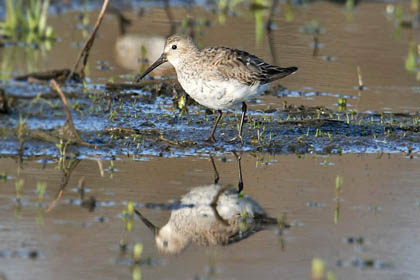
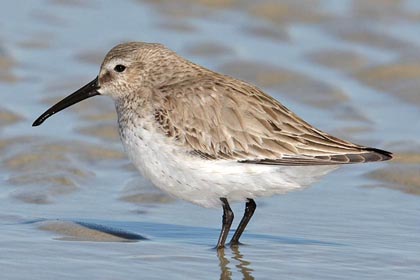
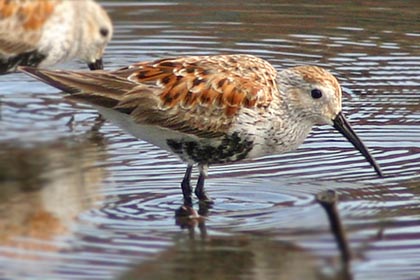
The depicted birds are adults in breeding plumage, with the distinctive black belly which no other similar-sized wader possesses. The winter Dunlin is basically grey above and white below. Juveniles are brown above with two whitish "V" shapes on the back. They usually have black marks on the flanks or belly.
The legs and slightly decurved bill are black. There are a number of subspecies differing mainly in the extent of rufous coloration in the breeding plumage and the bill length. It should, however, be noted that bill length varies between sexes, the females having longer bills than the males.
The nest is a shallow scrape on the ground lined with vegetation, into which typically four eggs are laid and incubated by the male and female parents. Chicks are precocial, however are brooded during early development. They start to fly at approximately three weeks of age. The majority of brood care is provided by the male, as the female deserts the brood and often leaves the breeding area.
The call is a typical sandpiper "peep", and the display song a harsh trill.
The Dunlin is one of the species to which the Agreement on the Conservation of African-Eurasian Migratory Waterbirds (AEWA) applies.
Apparent hybrids between this species and the White-rumped Sandpiper as well as with the Purple Sandpiper have been reported from the Atlantic coasts of North America (McLaughlin & Wormington, 2000, and external link below) and Europe (Millington, 1994), respectively.
|
|